Article · 3 August 2020
Conservationisms in times of pandemic (environmental)
Prompted by the Carcaixent fire and the pandemic, Ferran Dalmau calls for investing in prevention to tackle the environmental crisis and forest fires.
By Ferran Dalmau – Rovira. Director of Medi XXI GSA
Forestry Engineer. Emergency and Civil Protection Technician.
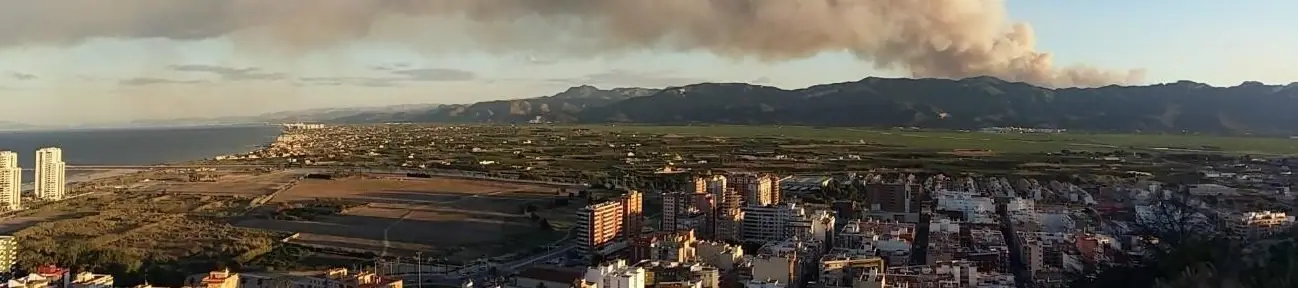
Four years ago, on June 16, 2016, the Valencian town of Carcaixent suffered a Great Forest Fire (those that burn more than 500 hectares) that affected 2,210 hectares. 80% of its natural heritage disappeared in a few hours. When 4 years have passed since that date, doubts arise as to whether we have learned anything from that crisis, or not. And the truth is that in these 4 years, from the point of view of preventing another fire on this local scale, very little has been done … in fact, if we look at the statistical data of this locality, in the next 10 years, It will burn again. And it is that, unfortunately, sometimes, not even with the worst crises, lessons are learned. Unfortunately, the Carcaixent fire is just a drop of water in a huge sea.
To give you an idea, in Europe, on average, some 500,000 hectares are burned, of which 375,000 are burned in the Mediterranean. In 2017, 890,000 hectares were burned, the worst year since 1985 in terms of forest fires. These episodes of Great Forest Fires, many times simultaneous, affecting large areas in moments of extreme weather, mean the destruction of habitats and landscapes by burning at extremely high intensity (much accumulated firewood equal to much energy released), CO2 emissions into the atmosphere, impacts on hydrological balances and water quality or irreparable loss of fertile soil … if this occurs recurrently, and in many places it does, it constitutes a true environmental pandemic that is nothing more than the prelude to desertification (with all its consequences).
As for direct fatalities, between 2000 and 2016 Europe recorded 488 deaths from fires. Between 2017 and 2018, there were 225 direct deaths in Portugal, Greece and Spain alone. Globally, the number of deaths from fires has increased by 276% if we attend to the Great Forest Fires of the United States, the Amazon, Australia, Siberia, Portugal, Greece … Think for a moment about the famous propagation curve and victims COVID19. What did we do when the death toll increased by forced marches? Why is this different with other crises? Because it must be borne in mind that indirect (human) victims, caused by polluting emissions, soil or water contamination, … are difficult to quantify since there are no reliable data. But, in addition, if we move away from the anthropocentric view of things for a moment, there are also more victims (animals, plants, complete ecosystems …). The health crisis has been brutal. It has generated an unprecedented socio-economic impact on our generation, and will be remembered as a historic milestone. A small microscopic virus has put a whole system in check, suddenly discovering that it is vulnerable and has panicked. Time will tell if the measures that are now beginning to be implemented are functional, or not. The problem is that there is another pandemic in progress, more brutal, more serious and deeper, but that seems that no one remembers. It is surprising how protocols have been adapted, generated “safe spaces”, articulated economic measures, modified regulations at a heart attack rate (if we look at the times that the “bureaucracy” has accustomed us to ordinary people) and yet, for facing the climate crisis, everything is extensions, long terms and big detours.
Some contextual data on forest fires
Economic losses in Europe from forest fires are 3,000 million euros a year. Every year. And it is estimated that in the coming years that figure, only in Greece, Spain, France, Italy and Portugal could reach 5,000 million euros a year. Every year. What if instead of spending on repairing damage we invest in preventing it? Can you imagine putting those annual amounts into forest fire prevention work and other actions that improve the ecosystem services of the agroforestry territory and peri-urban environments? It would be like having masks and respirators before a cursed virus arrives to generate a problem … it would be like anticipating problems before they occur … It is not easy to obtain reliable data on the impact that forest fires have on tourism. The loss of landscape and resources implies direct conditioning factors, for example, for rural tourism operations or indirect ones such as the loss of water reserves. In this prevention, the rural economy takes on special relevance. According to data from the Government of Spain, between 1970 and 2018, throughout the State, there were more than 628,000 fires that affected more than 8 million hectares. Despite this, it is important to highlight the fact that Spain is the second most forested country in the European Union behind Sweden. 55.2% of the total national surface (27.9 million hectares) is made up of forest land, of which more than 66% is forest. And that despite forest fires.
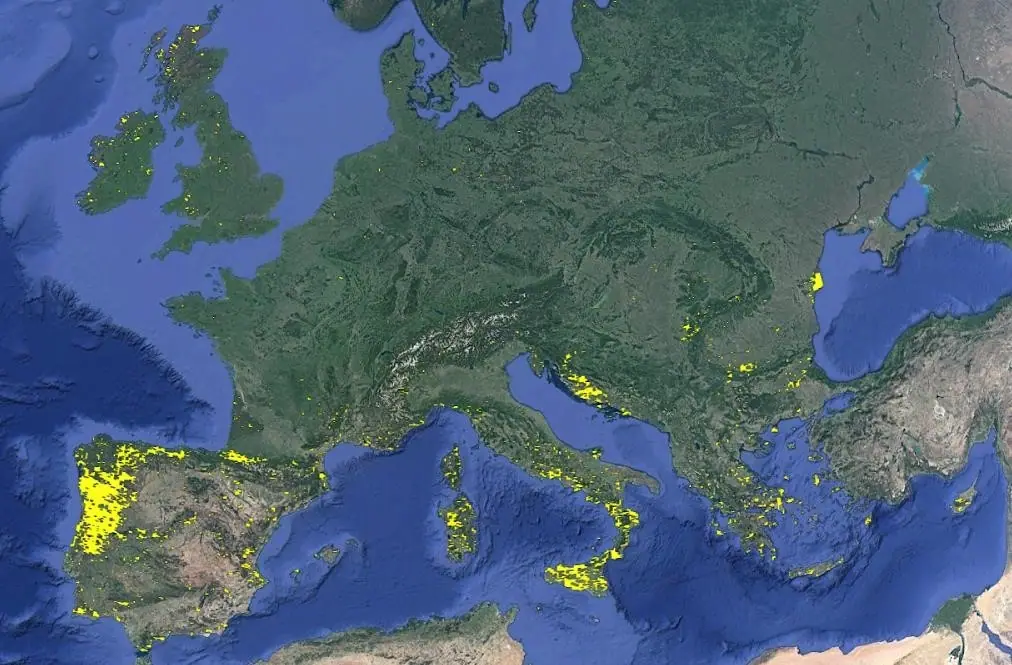
European mapping of forest fires for the period 2008 – 2019. The burned areas are shown in yellow and it is observed which are the European regions most affected by fire. Source: EFFIS
(European Forest Fire Information System)
Can you imagine what could happen if we invested part of the debt that is going to be generated to get out of the health crisis in preventing the environmental crisis? Can you imagine that Spain began to take advantage of that 55.2% of its territory in an orderly and sustainable way, generating jobs that would stop the rural exodus and mitigate in passing the effects of the Climate Emergency? Many people are unaware of the fact that Spain is the third European country in absolute forest biomass resources (behind Sweden and Finland). On the contrary, it is one of the countries that least takes advantage of forest resources and agro-livestock (both renewable) to generate energy, while we import tens of billions of euros a year in fossil fuels … In 2016, of total national production of electrical energy, biomass accounted for only 2.1%. In contrast, fossil fuels represent 35% of the electrical mix. Two data that will make anyone understand the current fires: According to data from the Spanish Society of Forest Sciences Spain has gone from having in 1975 about 456.7 to having 927.8 million m3 of timber volume in its forests in 2010. It it has doubled the “accumulated energy” in forest areas.
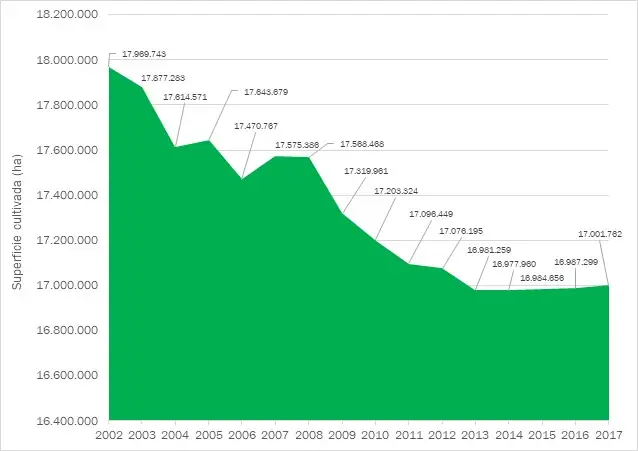
Evolution of the cultivated area in Spain (2002 – 2017). Source: Dalmau Rovira, F., 2019 based on data from the Ministry of Agriculture
It is estimated that 60.4 million tons are incorporated per year, and only 18.4 million are extracted. As we do not take advantage of it or manage it, it ends up burning. Does it seem logical to you? Maybe it isn’t too much. And this without counting agricultural biomass … which is even more important. Biomass currently generates a positive socio-economic and environmental balance, valued at 1,323 million euros, as the difference between the contribution to public coffers and the environmental savings (CO2 emissions and fire prevention) and the remuneration for the activity. It also generates a positive impact in labor terms. In the fuel collection, treatment and distribution jobs alone, 10,000 jobs could be created and almost 15,000 more jobs in the operation and maintenance of biomass boilers. In addition, the importation of more than 20 million barrels of oil and the emission into the atmosphere of 8.7 million tons of CO2 / year would be avoided. Forest biomass could create more than 594,000 jobs in the coming years. Imagine if the agricultural one is added. And this is just one example of what we could do, in a renewable, and also sustainable way. But it is not that simple. Unfortunately, we have some social chimeras to sort out before we get down to business.
We spend a lot on extinction, what if we invest more in prevention?
One of the previous questions that needs to be addressed is how and when public resources are used for fire. By not investing in forest management and prevention before fires, more is spent on extinction during and on restoration and damage repair afterwards. In 2017, Spain used 262 aerial means to fight forest fires for just over 27 million hectares of forest land. To make a comparison, the United States has 331 million hectares of forest land, and each campaign uses between 900 and 1,000 aerial means. Making a simple division, in Spain the ratio of air resources per million hectares is approximately 9.7 aircraft per hectare, while in the United States it is 2.75 aircraft per million hectares … And this despite the fact that it is a fact that a greater extinction effort does not necessarily imply an improvement in the results in episodes with extreme weather. Spain spends between 300 and 400 million euros a year on fire fighting (not counting money for damage repair, restoration, urgent work, compensation …), however, it invests between 100 and 200 million euros on prevention. What would happen if the resources allocated to prevention are equated? Perhaps fewer extinction resources would be needed? Would environmental, social and economic damage be saved? Would it be more sustainable? Each judge the answer to these questions, but it seems evident that it is not efficient or effective in social, environmental or economic terms to continue betting mainly on fire fighting.
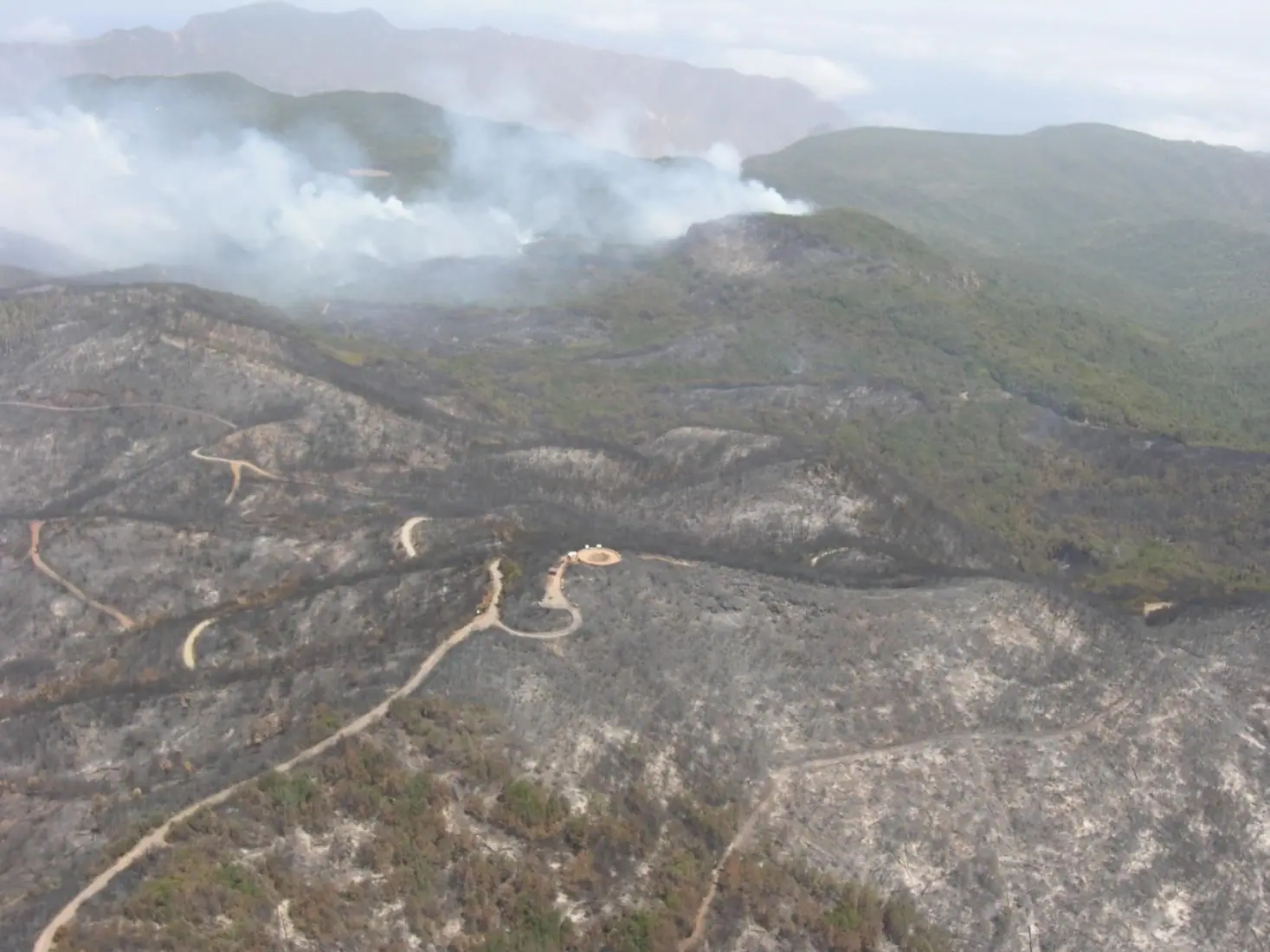
Forest fire in the Garajonay National Park in August 2012. A protected space is not protected by the fact of approving an administrative figure of “conservation”. Without effective land management, there is no protection. Source: Garajonay National Park
Can you “preserve” something that is dynamic and changing?
Climate change implies that things are going to change. “Change” according to the dictionary, is defined as “leaving one thing or situation to take another.” In other words, Climate Change will change the scenario. Precipitation, temperature, wind regimes, environmental humidity, droughts … and these changes will logically imply changes in the vegetation that houses the territory. The dictionary defines “conserve” as “maintaining or taking care of the permanence or integrity of something or someone”. And this same description, applied to the term “conservationism” (understood in ecological terms, not ecology) suggests a question: Is it possible to conserve a forest, a space or an ecosystem in the context of climate “change”? At what cost? Does it make sense to try to “preserve” something that is going to change, if not disappear, by a force of change greater than anthropocentric power? (the natural power, come on). What if instead of focusing efforts on “conserving” we do so on “adapting” our agroforestry spaces to this “new reality” that climate change implies? Again, if the dictionary is used, adapting can be understood as “accommodating, adjusting something to something else” … What if instead of “conserving” we adapt, adjust, or adapt the policies of forest management, biodiversity, to the scenario what will come? What if we assume that we cannot conserve something in a changing environment? What if we understand that perhaps we can only aspire to help in this adaptation process? The idealized and pristine image that some sectors of conservationism have of the territory causes its environmental sensitivity (fantastic and wonderful) to be translated into a static management of something dynamic. Something that by definition seems impossible. Perhaps, and it is worth emphasizing the perhaps, because there is not only one way to address these issues, it would be interesting to delve into the question of whether it is sustainable to try to “conserve” at all costs, or on the contrary, it is necessary to work from already, proactively, in adapting to the reality that is coming. Another proposal would come from the fact that when a project is proposed by a City Council and financed by the EU (having passed a double filter) the procedures are substantially simplified in order to start its development.
GUARDIAN, a tool for adaptation to (climate) change.
Most of the information available at the moment predicts a drier and warmer future for the Mediterranean, with more recurrent and intense droughts. Under this scenario, all the vegetation that is outside the climatic range (the one that requires more water, or less temperature, or better soil, for example) will gradually weaken and become ill (due to forest pests that will act as a pandemic, for example) . With weakened masses, and in scenarios of persistent drought, fire, in its ecosystem role as manager, will finish the job by eliminating those species that no longer “fit” in a certain territory. The person who reads these words understands that even if human causality were reduced to zero, something quite unlikely, unfortunately, there would still be fires like the one in Llutxent in 2018, caused by lightning and with catastrophic results. It affected more than 200 houses. And also understand that the only thing in the hands of the people who manage the territory is the state of the stage in which the battle will be fought. Neither the day, nor the time, nor the place, nor the weather conditions. Simply, the state in which the stage will be.
In Carcaixent, in 2006, 10 years before the last Great Forest Fire, a small Community of Owners, with the help of the Generalitat Valenciana and the City Council, launched a prevention project. The 140 properties of that nucleus and the Public Administrations invested in planning and executing self-protection measures. They formed, and endowed the nucleus with a defensive system against forest fires. There were those who considered the investment of 921.76 euros per property (counting public aid and private investment) very expensive … but 2016 came. And that investment was amortized at once. Furthermore, if preventive work is carried out in urbanized environments, fewer means of extinction are needed to defend it, and more forest hectares can be saved … if it is not invested, most of the means are used to protect houses. In this sense, the GUARDIAN, financed by the European Commission to mitigate the effects of Climate Change, is the corrected and expanded version of that original initiative that began 14 years ago now in the town of La Ribera Alta del Xúquer. The innovative idea is both simple: from the water that the risk areas of the Vallesa de Mandor, Masía Traver, València la Vella, Els Pous, La Canyada, etc., send to the EDAR Camp de Turia II, it will regenerate a very small part and it will be used as a resource in the defense against forest fires by applying prescribed irrigation to generate green firewalls. In the contribution of high quality reclaimed water to the natural environment to mitigate droughts that may come and reduce the flammability of vegetation in strategic areas. To fight forest fires if they occur. The GUARDIAN is a Valencian circular economy, applied, and shows that “it always seems impossible, until it is done.” The incorporation of Public Universities with their experience and knowledge in forestry to maximize the use of water, and the analysis of economic flows, CETAQUA as a technological center, HIDRAQUA as experts in the integral water cycle, and the Riba-roja and Paterna City Councils, as managers and as beneficiaries of the initiative, have made this project a magnificent tool for adapting to the change we are experiencing. After a year and a half of technical documentation, permits, procedures and papers, work will begin on the ground in September, logically focused on adapting these areas after what was learned in 2016 at Carcaixent.
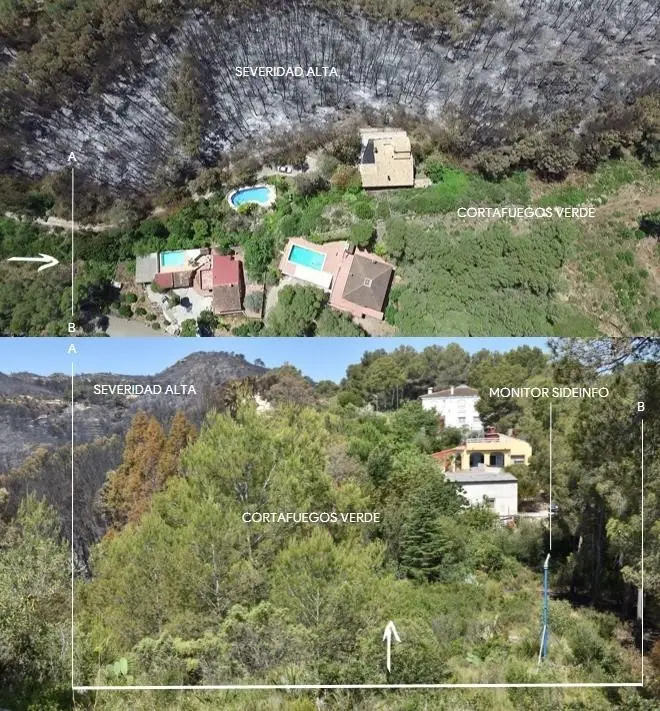
Green firebreak in Carcaixent that received the impact of the fire and helped in its containment, allowing Emergency Services to defend the area, 2016. Source: Medi XXI GSA.
The last dictionary definition of the word “adapt” describes it as a concept of biology, “saying of a living being: Accommodating to the conditions of its environment.” Look, I don’t like it, because we have come this far because of our unconsciousness as a society, and because of a series of decisions that we must review, but the fact is that the environment is going to change. And given that fact, we have two options. Adapt, or not. And each option has consequences, so the question is simple:
What do you prefer? Adapt or …?
A replicable solution
GUARDIAN shows that reclaimed water can protect the wildland-urban interface. Let us know if you would like to apply it in your municipality.