News · 21 December 2020
The GUARDIAN project begins forest management work for fire prevention in 37 hectares of the Parc Natural del Turia
Medi XXI, supported by the UPV, begins thinning and managing 37 strategic hectares and planting over 2,000 native, less flammable plants.
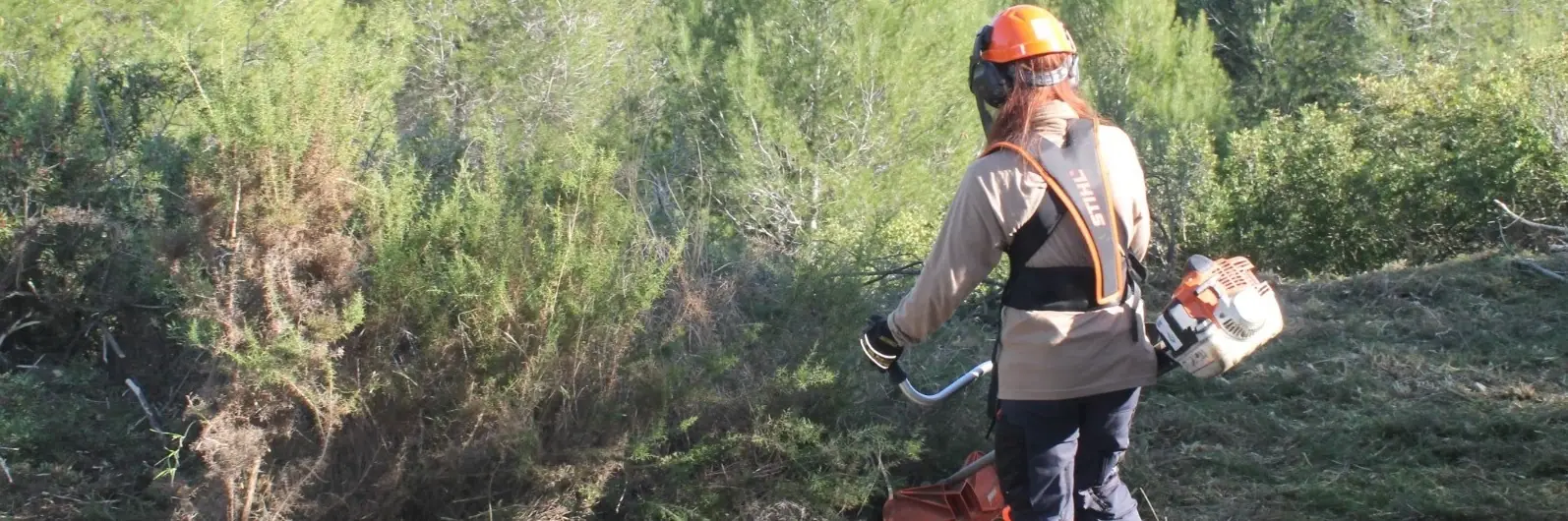
This work is carried out by the partner Medi XXI GSA, an environmental engineering team specialised in this field, with the support of the Universitat Politècnica de València
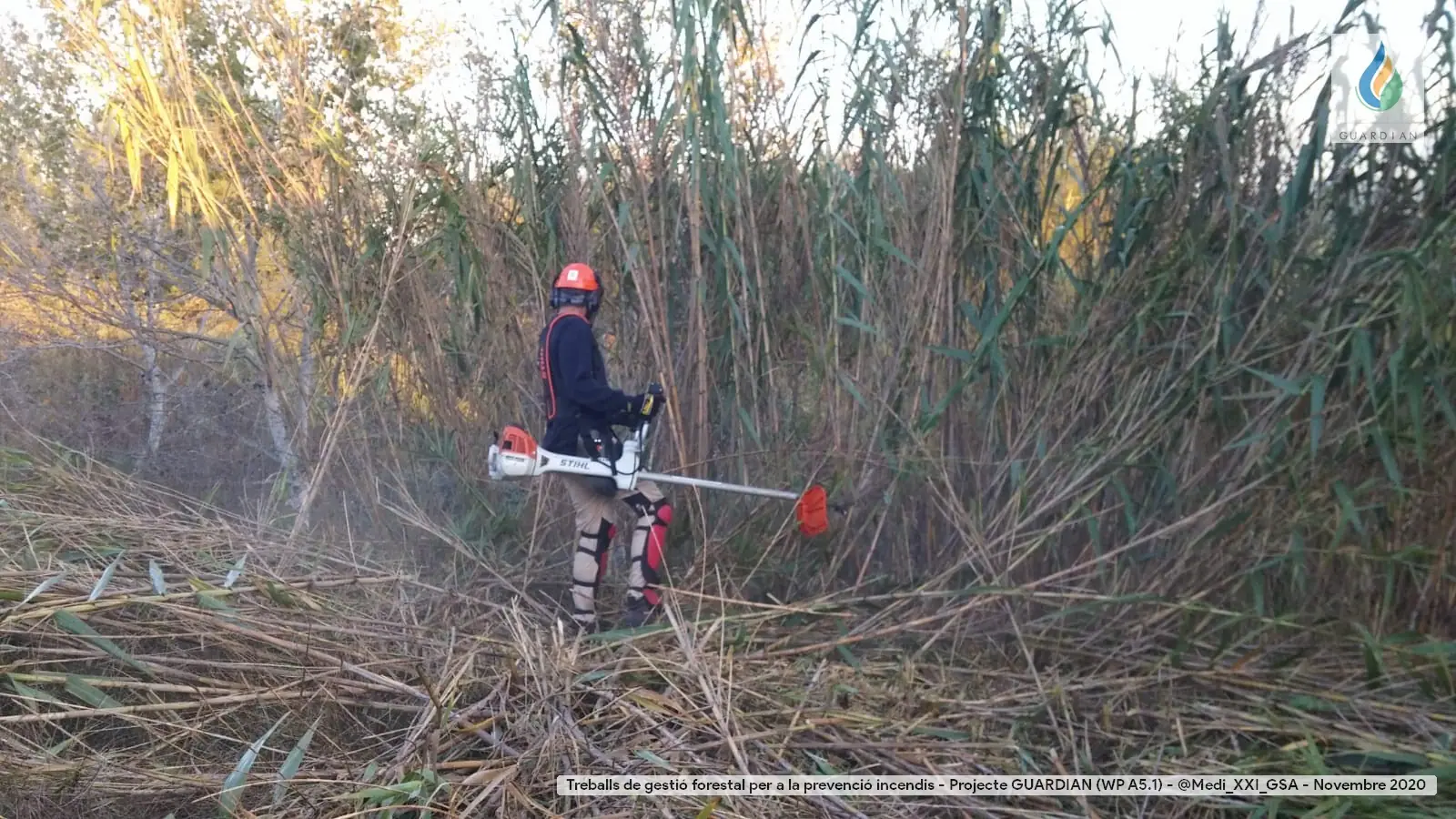
GUARDIAN is the EU-funded project to increase resilience to fires in the Urban-Forest Interface of the Parc Natural del Turia. For the creation of these defensible areas against forest fire, the project contemplates the use of reclaimed water to establish wet defensive lines through the creation of green firebreaks, classic silvicultural works, such as clearing, pruning trees, or thinning of diseased, dominated trees or trees that provide excessive density, as well as the elimination of cane fields. In total, in the coming months more than 37 strategic hectares will be managed with the aim of preventing an urban fire from spreading to the Natural Park, and a fire in the Turia or its surroundings from affecting populated areas.
According to Antonio Del Campo, professor at the Polytechnic University of Valencia, “based on the physical principles that govern the fire triangle, the modification of the fuel (vegetation) affects and modulates the behavior and effects of the fire and the costs of extinction. Forest fuel can be modified through three processes: reduction or decrease of the available fuel load; conversion by which some fuels are replaced by others with different flammability and isolation or fragmentation, consisting of isolating large fuel compartments by means of green firebreak strips / areas. In reality, these processes overlap in the practice of preventive forestry”.
Hence, the first part of the work carried out by the Medi XXI GSA team involves clearing the forest mass, which has a high density due to the natural regeneration of previous fires. This density of trees per hectare often exceeds the optimum and generates serious competition and disease problems, reduces infiltration into aquifers and also considerably increases the risk of fire in such a sensitive area. The objective is to achieve a balance that guarantees the continuity of the forest, improves infiltration, mitigates the effects of Climate Change and also helps in the prevention of fires.
In the second phase of the work, more than 2,000 plants of autochthonous Mediterranean species of lower combustibility (ash, box, rowan, mastic, myrtle or durillo, among others) will be planted, which will act, together with the prescribed irrigation, as green fire breaks. With this combination of actions, the aim is to prevent the impact of high intensity fires against populated areas and to prevent an urban fire from escaping into forest areas.
According to Del Campo, “within the types of forest fires, crown fires are especially serious, which are the most severe and cause the greatest impact on ecosystems and human societies. These fires occur when a surface fire creates enough energy to preheat and burn live fuels high above the ground”. Likewise, he adds that “the physically based approaches that corroborate this assertion are those that have given rise to the four principles of fire-resistant forests (Agee and Skinner, 2005). These principles include reducing surface fuels or low shrubs, increasing living canopy height, decreasing tree canopy density, and keeping large trees more resilient to fire because of their taller canopies and thicker bark”.
With these preventive and self-protection actions in the event of a forest fire, the presence of these irrigated species and the associated hydraulic infrastructure will allow the Emergency Services to have the capacity to defend the area before the fire reaches the buildings. In the same way, if the fire starts in the area of the houses, it will find a protection strip with the ability to retard a rapid spread to the forest area, thus protecting the Turia Natural Park. For these works, Medi XXI GSA has hired a reinforcement of forestry specialists made up of 10 people, who under the direction of expert personnel in environmental engineering and with the support of the UPV have begun work to reduce the risk of fire in the vicinity of the urbanizations in the river park area of both Riba-roja and Paterna.
Forest fires, as they have been known until now (frequency, seasonality, intensity, etc.), are undergoing a profound change motivated, among other factors, by climate change. Thus, it is expected that large fires will become, if measures are not taken, increasingly frequent and intense, and therefore more dangerous for the population and the natural environment. GUARDIAN contributes to mitigating this situation by generating a more resilient and safer landscape, for nature, and for its inhabitants.
A replicable solution
GUARDIAN shows that reclaimed water can protect the wildland-urban interface. Let us know if you would like to apply it in your municipality.