News · 15 September 2020
Francesc Hernández: “Water reuse is pure common sense”
Francesc Hernández, head of the UV Water Economics Group, discusses Guardian’s viability, sustainability and replicability and the cost of not acting.
Interview by iambiente with Francesc Hernández, professor and director of the Water Economics Group at the UV.
Increasing fire resilience in an area of the Parc Natural del Túria such as the forest of La Vallesa. This is the aim of the ambitious Guardian project, an initiative that is committed to the use of reclaimed water. It is funded by the European Union and led by the town councils of Riba-roja de Túria and Paterna, Hidraqua, Medi XXI, Cetaqua, the Universidad Politécnica de Valencia and the Universitat de València (UV). The latter plays a specific and extremely important role in any work of this kind: the economic and environmental one.
Heading this challenge is Francesc Hernández, professor and director of the UV’s Water Economics Group. “Our responsibility in the Guardian project focuses, above all, on three pillars: viability, sustainability and replicability. We must highlight its added value.”
Monetary valuation
—How important is economic viability in a project like Guardian?
—Any action and, of course, everything that is planned in Guardian has to be economically viable. What does this mean? Comparing costs and benefits. We study both the costs of the investments to be made and the costs of operating and maintaining them over time. It is in the analysis of the benefits that we apply novel techniques: identifying and quantifying the social and environmental benefits generated. Above all because, in these cases, the benefits are not obtained directly from the market, nor are they valued in euros. They have to be identified, and rigorous techniques have to be applied to value them in monetary terms. Only in this way can we speak of the real viability of the planned actions.
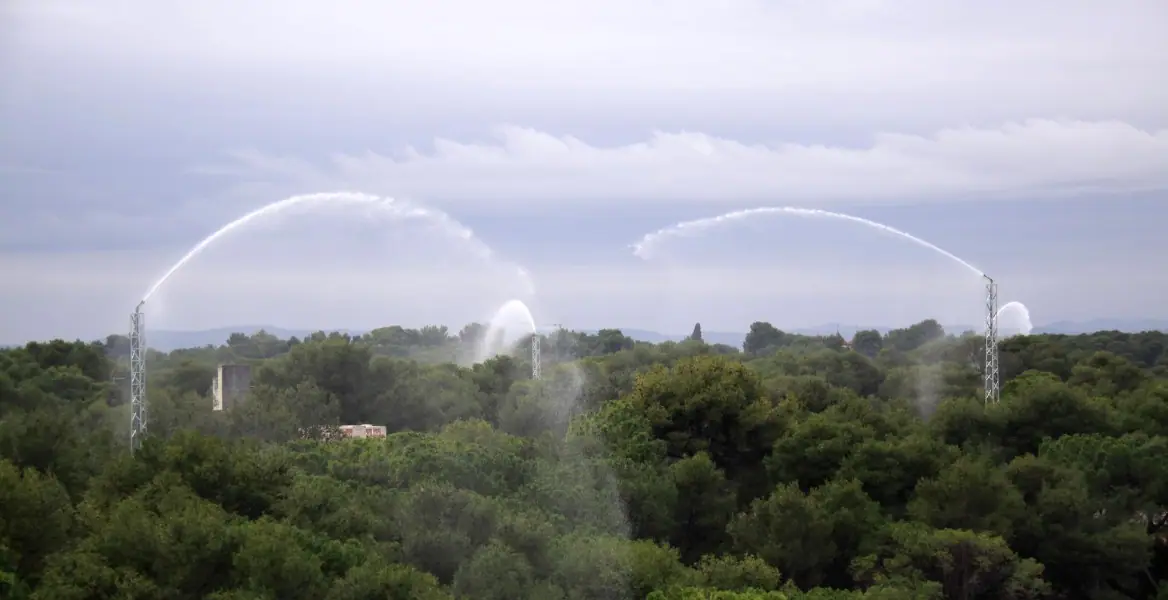
Thanks to the Guardian project, we are managing to restore the La Vallesa natural park, and that has magnificent environmental and social effects. But either they are quantified or, as often happens, they are not taken into account. We use methods to quantify these benefits derived from water reuse and its use for environmental purposes. We use part of that flow to reduce the risk of fire by stepping up prevention in a sensitive area where a fire would have serious consequences for the forest and urban environment.
Circular economy
—The Guardian project is a clear example of the circular economy.
—Yes, and we are aware that action on the circular economy is usually affected by social and administrative barriers. Very often it is not considered a priority. Either because it isn’t possible at the time, or the budget isn’t ready, or because it is put off until later. All of this is very common in actions where most of the benefits are environmental.
So what we have done here, in a novel way, is to develop a concept known as the ‘cost of not acting’. In the sense that if, in the end, a circular economy project were not carried out – despite being viable – there would be a record showing that this was not a neutral decision. In other words, it will have very negative consequences for society. What’s more, these costs will be duly quantified. Ultimately, it is an awareness-raising mechanism to promote these circular economy projects.
—What exactly does it mean for a project like this to be sustainable?
—The term is very broad and generic. But what we mean is that this project will endure over time. Guardian involves numerous actions and investments that have to last beyond the lifetime of the project itself. These are actions for the present and the future. It has to serve the next generations. But what mechanisms guarantee that this is sustainable? As with any circular economy action, if everyone benefits, then everyone has to share the costs. This means mechanisms have to be put in place to guarantee its maintenance over time. This is what we are in charge of at the UV, and it is a relevant issue that is highly valued in European projects.
Implementing Guardian
—And it is also very important that the project can be applied elsewhere in the world.
—There are many areas in more or less similar circumstances, and this experience should make implementation much easier. So we are also working on building a kind of guide or action plan that exponentially multiplies the value of the Guardian project’s actions in other regions facing similar problems.
—Would such replicability be possible in other settings? In urban areas too?
—Yes. Although personally I wouldn’t draw a line between urban and non-urban settings. Guardian is an example of a circular economy project in which urban wastewater is regenerated – specifically at the Camp de Túria II treatment plant – and comes to be regarded not as waste but as a new resource. But how do we achieve this? It depends on the use it is going to be put to. In the case of the Guardian project, this new resource is used to restore a natural park and also to reduce the risk of fire. The consequences are therefore both environmental and social, given how close the towns are to the forest. It is a very clear benefit. We are restoring a site because of its great natural value and, moreover, for the use and enjoyment of society as a whole.
The role of reuse
—What role should reuse play in water management?
—Reuse is the key piece that helps us close the loop of the water cycle. We take high-quality water from nature, use it in urban areas and turn it into wastewater. This water undergoes treatment, but it does not reach its original quality. It meets regulatory requirements but does not recover its original characteristics. It is therefore an effluent that is discharged into the environment without being put to direct use.
Reuse, on the other hand, means that once the water has been used, it is regenerated to a quality good enough to be used again. Treatment is not just about removing or reducing certain pollutants; it allows us to return the water to its natural cycle so that it can be used where it is most needed. Reuse is pure common sense. It is the reasonable thing to do, but it has to be put into practice. We shouldn’t stop at the concept; we should help to implement it. If there are barriers, we must be able to remove them and turn the potential of the circular economy into reality.
Reuse and agriculture
—One of the clearest examples of reuse is in the agricultural sector.
—Yes, reuse has a direct application in agriculture. It makes no sense to use very high-quality water for irrigation, drawn mainly from aquifers. Many crops don’t need water like that. Rather, they would need water with nutrients, which could perfectly well come from a regeneration process at a treatment plant. It would even benefit agriculture. What’s more, we would stop using water that could be diverted for drinking. Actions of this kind would be very positive not only for the environment but also for society as a whole. In this way, we will help to use such a valuable and scarce resource as water reasonably and efficiently.
But its use is not limited to agriculture. It has many others. The restoration of natural sites is one of them. The La Vallesa natural park would be one example, but there are many more: landscapes of great environmental value whose condition is deteriorating because of a lack of water, which future generations might therefore not be able to enjoy. Simply by using reclaimed water, these areas could be restored. The example of wetlands is clear and obvious. Reclaimed water also has urban uses, such as street cleaning or watering gardens.
International initiatives
—What other experience have you had in the field of reuse?
—At the UV Water Economics Group we are promoting reuse through various initiatives. At international level, mainly on behalf of the United Nations environment programme, and also for the World Bank. It is worth noting that in many countries around the world wastewater treatment is still not considered a priority. It isn’t seen as necessary and is therefore regarded as something of a luxury. That is why the United Nations asked us to work with them to convince various governments that treating wastewater was cost-effective. In other words, the idea was not to use arguments based on common sense or on human rights themselves, but solely to demonstrate its cost-effectiveness. All the effects of not treating wastewater, on both human health and the natural environment, were quantified in monetary terms. We compared this with the cost of acting, by building basic treatment facilities, so that the governments themselves could see how advisable and cost-effective the actions were.
At European level, we are taking part in several projects funded by the European Commission to promote initiatives for the reuse of reclaimed water in different sectors. I would also like to highlight the actions we have been carrying out in the Valencian Community within the framework of the Generalitat Valenciana and Universitat de València Chair to transform the economic model through the circular economy.
An essential resource
—In the end, society – especially the part of it that turns on a tap and water comes out – is not at all aware of the importance of such a basic resource.
—Yes, I totally agree. When you turn on the tap and water comes out, you don’t worry about anything else. There is obviously a lack of awareness, which it would be very important to address through education. We should start with young people. But I am also in favour of taking more immediate measures in parallel. The public authorities and the companies involved in water supply and management are aware of the importance of certain actions. We must provide the means for this, especially with criteria that guarantee the proper use of water and the recovery of all costs through rational tariffs. A service that is for everyone must be paid for by everyone and, moreover, as the Water Framework Directive requires, in a way that guarantees efficiency and fairness.
A replicable solution
GUARDIAN shows that reclaimed water can protect the wildland-urban interface. Let us know if you would like to apply it in your municipality.