News · 15 September 2020
Del Campo: “What drives fires is the greater presence of that fuel, which is wood”
UPV professor Antonio del Campo explains how keeping trees hydrated with reclaimed water can slow fires, and why forest fuel is at the root of the problem.
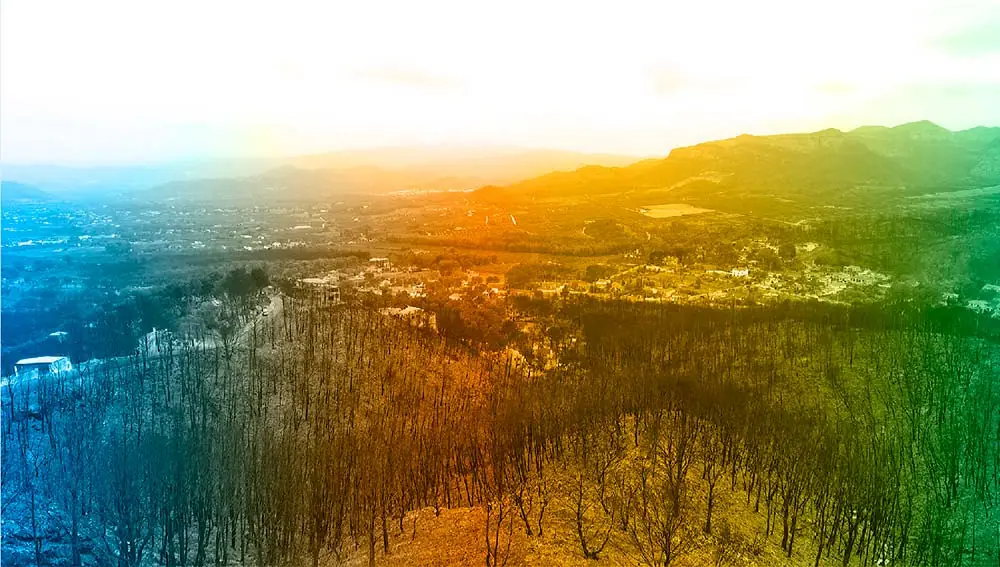
Interview by iambiente with Antonio del Campo, professor at the Universidad Politécnica de Valencia.
Forest, water and fire are the three elements researched by Antonio del Campo, a professor at the Universidad Politécnica de Valencia. From that institution, he is working on the Guardian project, which is set to become an international benchmark in fire prevention and extinction. The project is taking place in La Vallesa and its wildland-urban interface, in the Parque Natural del Turia, where it passes through Paterna and Ribarroja. “Our role has to do with the forest–water pairing and how it can be used during forest fires,” he says.
To make this easier to understand, the researcher draws a comparison. “Let’s think of the forest as a collection of clay jugs that collect water,” he explains. Each jug is a tree, which gradually loses its water through consumption and evaporation. Now the fire has to advance and finds all the jugs full of water. “As it breaks those jugs, it finds that it has a lot of water to evaporate in order to keep advancing,” he describes.
This is essential to take energy away from the fire and put it out. “The more water there is inside the trees, the harder it will be for the fire to spread,” he states. The professor is therefore researching the dynamics of water inside trees and how those dynamics can be modified using reclaimed water.
Prevention is better than cure
In a pre-emergency situation (when it is possible to anticipate or foresee a fire), we will need to know how much water must be supplied to the trees in order to prevent it. “It’s not about getting out a sprinkler or a hose to water from above, because that water evaporates straight away,” he points out. The water has to be inside the tree, as that is the best way to fight the fire.
The goal, therefore, is for those “jugs” to be always full, especially in an alert situation. “It’s much harder for a fire to take hold in a hydrated forest and, at the same time, it will be easier to fight if it does happen,” he insists. This is how, through this metaphor, he explains the fundamental elements of the Guardian project.
Soil–plant–atmosphere
His work involves analysing these spatial and temporal dynamics of water in order to act accordingly on the hydration and dehydration of the trees. Ecophysiologists call this concept the soil–plant–atmosphere continuum. “We need to know how much water the soil holds and how it moves through hydraulic conductivity until it reaches the plant,” he explains.
The tree, acting as a reservoir, will then take up and release the water demanded by the atmosphere. “We have to study the state of water in those three systems and also how much the tree is able to retain.” This information is collected using sensors and scientific instruments.
Unexpected behaviour
There is one new finding. On days with a levante (easterly) wind, there is a lot of atmospheric humidity, which affects all these dynamics. So, when the trees are dry but the atmosphere is relatively humid, they close their stomata to retain water. The team has also detected another behaviour at night that they did not expect.
“They open their stomata slightly for night-time transpiration, but humidity is higher and so the atmosphere’s demand for water is lower, which gives them some relief and they are able to continue with their mechanisms to keep rehydrating,” explains Del Campo.
The hydration process
Ultimately, what the UPV research team is trying to do is to characterise all these dynamics. Whether it is winter or summer, they will need to know how much water the forests need, how to supply it and how it will be lost.
The main route by which water enters a tree is through its roots. Reclaimed water is used for this irrigation by means of water cannons that reach a considerable radius. “A tree can also absorb water through its stomata, in its upper part, even though that is not the main entry route,” the professor points out.
But is overhead irrigation efficient? They have not yet been able to obtain scientific evidence on this point. “It would also be very useful if the fine parts of the tree, which are the leaves and are the first to face the fire because they ignite faster, could be better hydrated to fight it,” he explains. This is something they are still investigating.
Natural fire regimes
There is an international trend to challenge the ways of dealing with fires. Natural fire regimes have changed throughout history. In the era of hunter-gatherers, for example, the frequency of fires was very low because they depended on a lightning strike or something similar.
On the other hand, until the Industrial Revolution or the arrival of butane gas, people consumed wood as fuel. This helped to keep forests permanently clear, together with intensive livestock grazing, which has now almost disappeared. “Forests didn’t look the way they do today because they were clean, and that meant there weren’t as many fires,” says Del Campo.
Fuel in the forest
With fossil fuels, traditional fuel is no longer used and builds up in the forests. “What drives fires is the greater presence of that fuel, which is wood,” he states. According to the professor, institutions and public authorities now seem to have realised this. “As well as having resources, it is essential to look at fuel as the source of the problem, together with the process of climate change.”
A replicable solution
GUARDIAN shows that reclaimed water can protect the wildland-urban interface. Let us know if you would like to apply it in your municipality.