News · 21 December 2020
GUARDIAN starts up the Water Regeneration Station that will allow its reuse for the prevention of forest fires
The mayors of Riba-roja and Paterna visit GUARDIAN’s new water regeneration plant, which removes micropollutants so the water can be reused.
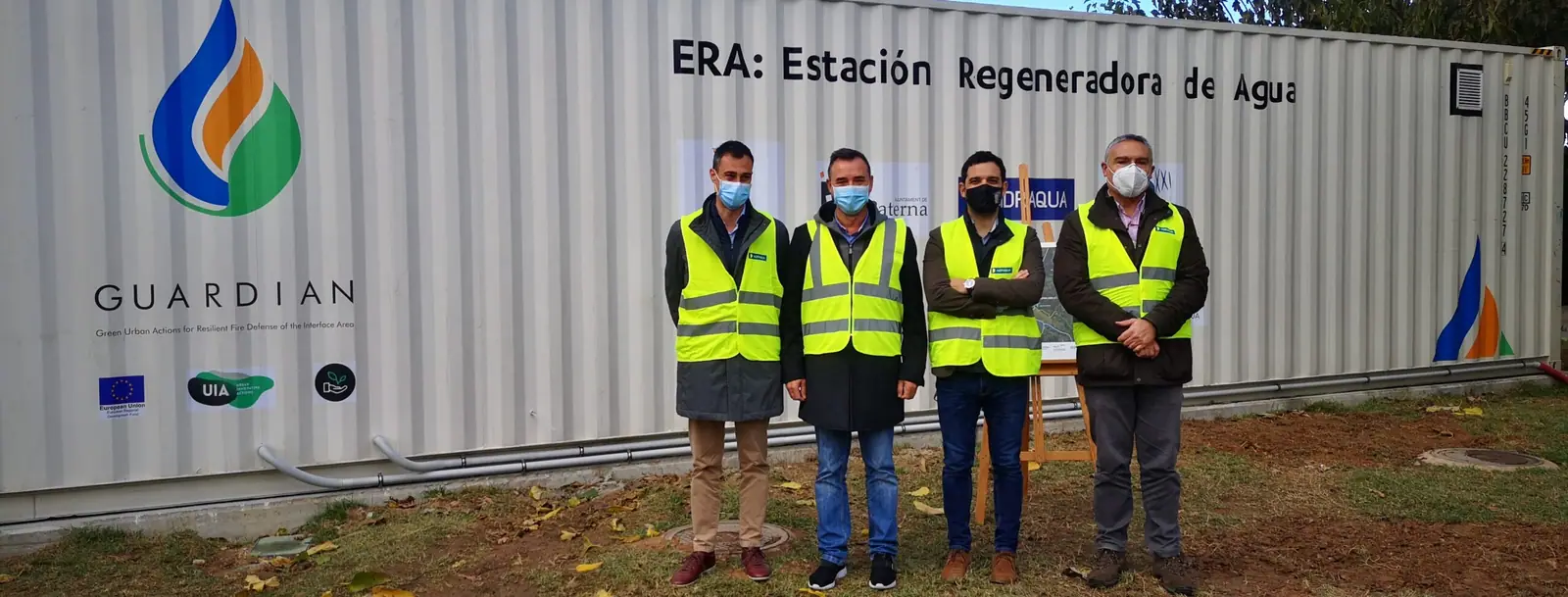
This morning, the mayors of Riba-roja de Túria and Paterna visited the GUARDIAN project’s Water Regeneration Station. It is an advanced water treatment plant that was installed this week, and which will be in charge of improving the quality of the water that is treated at the Camp de Túria II Treatment Plant. Thus, it will be reused in the green barriers and fire prevention in the area of action of the GUARDIAN project, in the Turia Natural Park. In addition, part of the reclaimed water will be contributed to the La Vallesa reservoir, a specially protected wetland, to improve the current state of the water body.
Specifically, this project, funded by the European Union through the Urban Innovative Actions call, seeks to increase resilience to fires through reclaimed water in an urban-forest interface area of the Túria Natural Park. Participating in the project are the Town Halls of Riba-roja and Paterna, Hidraqua, Cetaqua, Medi XXI, the Polytechnic University of Valencia and the University of Valencia.
During the next few months, the operational parameters of the treatment plant will be adjusted in order to maximize the efficiency of the process and the quality of the water obtained. In such a way that, once the hydraulic works for the storage and distribution of this water are completed, the installation can go into operation.
CETAQUA and Hidraqua, the two companies of the integral water cycle that participate in the project and responsible for this part of it, have been in charge of explaining this installation to Robert Raga and Juan Antonio Sagredo; also accompanied by representatives of EPSAR. “The water obtained in conventional treatment plants once it has undergone the primary and secondary treatments is water that allows it to be discharged into the natural environment. However, in the case of the GUARDIAN project, a water of an even higher quality was required, where it focused on the elimination of phytosanitary products. These micro-pollutants are common in the aquatic environment and come mainly from pesticides, pharmaceuticals and personal care products, or industrial compounds, among others”, explained those responsible for Hidraqua and CETAQUA during the visit.
To choose the appropriate treatment for the elimination of these micropollutants, a previous study was carried out through analysis of the purified water collected on different days and hours. The ultimate goal was to know what type of micropollutants were present in order to use the most advanced technology that would allow their elimination.
Finally, the plant is made up of three phases. The first one is in charge of removing any solid in order to optimize the regeneration processes. The water then passes through a tank where it will mix with the ozone that will be produced at the station itself. This technology makes it possible to degrade the molecules of micro-pollutants in an efficient way, as well as being a powerful disinfectant. Next, the water goes through an activated carbon biofiltration system where the products obtained in the previous stage are degraded. Lastly, a chlorination system adds an additional disinfection barrier in order to guarantee complete disinfection of the water and its safety.
Once the water has passed all these phases, it is pumped through a pipe to a first tank where it will be stored and from there it will be conducted for its contribution to the La Vallesa reservoir, as well as for its use in the protection and prevention areas of fires in the area of action of the GUARDIAN Project, in the Turia Natural Park.
A replicable solution
GUARDIAN shows that reclaimed water can protect the wildland-urban interface. Let us know if you would like to apply it in your municipality.